Introduction
In Australia, the law creates a regulatory framework for road and vehicle design, and expectations for permitted or prohibited road user behaviours (road rules). As written, laws and regulations are invisible on the roads yet provide key rules that determine how roads and vehicles are designed and how people are expected to behave in road environments. Law therefore plays a central role in creating a Safe System that can achieve positive road safety objectives.
As conceptualised by Theeuwes and Godthelp (1995) the ‘self-explaining road’ is a ‘traffic environment which elicits safe behaviour simply by its design’ (p. 217). While this means that roads should be designed in ways that informs road use for modes and vehicles, it also supports the use of road elements – signs, markings, geometry, road surface, lighting, etc, to prevent behavioural errors that can result in crashes (Theeuwes, 2021). The concept of self-explaining roads aligns with the Safe System approach, under which the design of roads and intersections should match their traffic function and support safe road user behaviour (ITF, 2022). Poor design of roads, vehicles, and behaviour standards contribute to road user error, which can lead to serious injuries or fatalities (Williamson, 2021). For vulnerable road users, education and understanding of expected behaviours by all road users contribute to achieving positive road safety outcomes (Parliament of Victoria, 2024; Tierney, 2015).
Each part of the self-explaining road – road infrastructure, vehicles, and road users – are governed by different laws. These laws, in whatever form they take, should ideally complement, or align with, each other. If a law states that certain road user behaviours are triggered by the existence of certain road infrastructure, then that infrastructure should be required by road design guidelines and standards. If road design guidelines and standards identify vehicles by certain features, then laws that direct how these vehicles may be ridden or driven by road users should be aligned to these features, and so on.
Misalignment between road rules and road design or vehicle design guidelines and standards creates liability risks for road users for example, that may breach road rules despite following visual cues provided by road design or by use of certain vehicles on the road. Law therefore plays a significant role in creating a self-explaining road as part of a broader Safe System that is key to crash prevention.
This study aimed to explain legal principles and structures that contribute to creating law that is aligned across parts of the self-explaining road and provide illustrative examples of how laws may be, or may become, misaligned. Previous studies have made comparative reference to law affecting specific issues relating to the self-explaining road (Muir et al., 2018; Schramm et al., 2014). This study responds to a gap in existing research by providing analysis of the relationship and alignment between laws affecting parts of the self-explaining road using legal research methods.
Method
This study comprised a review of specific standards, rules, or legislative provisions in laws that affect road design, vehicle design, and road user behaviour in Victoria, Australia as an example jurisdiction. This study used a doctrinal research method to identify sources of law and to interpret those laws to identify illustrative examples of misalignment.
Legal ‘doctrine’ describes the synthesis of ‘rules, principles, norms, interpretative guidelines and values’ (Mann, 2010, p. 55) to specific subject matter. A doctrinal method of research has two steps; first to locate and identify relevant law, and second to apply that law to given facts or circumstances (Hutchinson & Duncan, 2012; Theil, 2025). In general, each step of doctrinal research must be done manually. While law can be searched by title and keywords in legal databases, databases lack capability to identify and compare specific legal provisions across different legal sources relevant to the self-explaining road.
Doctrinal method: locate and identify laws for comparison
Australia’s legal system structure, distribution of regulatory power, and prevalence of secondary ‘quasi-legal’ sources of law affect how laws affecting road design, vehicle design, and road user behaviour were located and identified.
Distribution of powers to regulate road transport
Australia is a federation with national (Commonwealth), state/territory, and local governments. The division of regulatory powers between these levels of government is determined by the Australian Constitution Act 1901 (Cth) (Constitution) (James et al., 2024). As a subject, ‘transport’ (encompassing roads, rail, public transport, etc) is the responsibility of Australian states and territories because it is not identified for regulation by the Commonwealth in the Constitution section 51.
On this basis, Commonwealth regulation of transport is mostly indirect. For example, Commonwealth laws that impose tax on fuel, or impose road user charges on heavy vehicles, are enacted using powers to impose duties of custom and excise (Constitution section 90). The Commonwealth can also enact laws on matters referred to it by states and territories (Constitution section 51(xxxvii)). The Heavy Vehicle National Law and Rail Safety National Law are examples of laws made by referral. ‘Model rules’, ‘guidelines’ and ‘standards’ can be created by public authorities, regulators, or peak bodies, like the Council of Australian Governments, National Transport Commission, Austroads, or Standards Australia. These constitute secondary or ‘quasi-legal’ sources of law within the overall regulatory framework.
Otherwise, state and territory laws regulate most transport matters directly. Road safety standards, road rules, and driving offences are established or authorised by laws such as the Road Safety Act 1986 (Vic). Laws such as the Transport Integration Act 2010 (Vic) are used to coordinate transport systems, and Transport Accident Act 1986 (Vic) provide for transport compensation schemes. Other state and sub-state (local) laws may affect transport on issues such as environmental standards and land use planning conditions.
Multiple levels of government are often involved in creating law that affects each part of the self-explaining road. Model rules provide a single reference point for road rules across Australia. Produced by the cooperation of states and territories through the National Transport Commission (1999), the Australian Road Rules (ARR) are non-binding, but are translated into law adopted by states and territories. In Victoria, the road rules established by the ‘Road Safety Road Rules 2017’ (VR) are closely aligned with the ARR in both form and substance. New South Wales, Queensland, Tasmania, Australian Capital Territory and Northern Territory also follow the ARR – in these jurisdictions, road rules are often similar to those appearing in the VR.
Multiple levels of government are also involved in laws that affect road design. Technical documents produced nationally include the Austroads Guide to Road Design (AGRD), Austroads Guide to Traffic Management (AGTM), and Australian Standards (AS), supplemented by technical publications from state and territory road authorities (Supplements) to provide jurisdiction-specific guidance to clarify, modify or supplement the overarching requirements. For example, as of October 2025, the catalogue of publications by the Victorian State Government, Department of Transport and Planning (2025) (formerly VicRoads) exceeds 1000 entries across disciples of road design, drainage, management, pavements, structures, landscaping, plus signalling and traffic management. Similar processes are adopted in states such as New South Wales and Western Australia (Austroads, 2025).
In contrast, vehicle design is regulated by the Commonwealth. The Road Vehicles Standards Act 2018 (Cth) establishes performance-based standards for road vehicles relating to safety, environmental performance, energy conservation, and technology that are then operationalised through the Road Vehicle Standards Rules 2019. Design standards for different vehicle types are set out in the Australian Design Rules (ADR). As defined in Vehicle Standard (Australian Design Rule – Definition and Vehicle Categories) 2005 (Cth), individual ADRs exist for two and three-wheeled motorised vehicles including mopeds, motorcycles and tricycles, and four-wheeled vehicles including passenger cars, passenger vehicles, buses, goods vehicles and trailers. ADRs are silent on pedal bicycles, electric bicycles (e-bikes) and electric scooters (e-scooters).
In this study, the distribution of powers meant that locating and identifying laws affecting parts of the self-explaining road required searches for both Commonwealth and state or territory laws.
Primary and secondary sources of law
So far, the term ‘law’ has been used in a general sense. More accurately however, law (and other legal terminology) has specific meanings. For example, ‘law’ can be made by Parliament (legislation, statute or Act) or created by iterative decisions of courts following the doctrine of precedent (common law, case law). Parliament, courts and tribunals are ‘primary’ sources of law.
Within primary sources, law is hierarchical. First, legislation creates rights and obligations that are legally binding on the entities to which it applies. Second, subordinate legislation (also known as ‘delegated legislation’) in the form of ‘regulations’ and ‘statutory instruments’ may be authorised by legislation to achieve its specific elements of the law’s objectives (James et al., 2024). Australia has a ‘common law’ legal system which means that, in addition to legislation and subordinate legislation, law can also be made by courts through judicial decisions (‘common law’ or ‘case law’). For example, ‘dangerous’ or ‘reckless’ driving and riding are common law concepts under the Road Safety Act 1986 (Vic) (Johnston & Antolak-Saper, 2023). Due to parliamentary sovereignty, legislation (and subordinate legislation) overrides the common law. In transport, legislation and case law are used independently and together. Failing to comply with legislation or common law may result in civil (financial) and criminal (imprisonment) penalties.
In Australia’s transport sector, government departments, public authorities, and peak industry bodies issue a substantial number of documents – for example the AGRD, AGTM, Supplements, and AS – that are followed by engineers and other road safety practitioners as a matter of practice, although they are not legislation or common law. While these documents are authoritative within the transport sector, they are ‘secondary’ or ‘quasi-legal’ sources within Australia’s broader legal framework. Failing to comply with AGRD, AGTM, Supplement or AS requirements may have administrative consequences, but will not become legally binding unless they have been directly incorporated into legislation or subordinate legislation as primary sources of law (e.g., VR rule 270 refers to AS1698 for approved motor bike helmets). In Australia’s transport sector ‘model rules’, such as the ARR discussed above, can also be a ‘secondary’ source of law. While not legally binding in themselves, they are used by regulators, peak bodies, road authorities and other stakeholders to inform consistent or uniform development of law across Australian state and territories.
The use of both primary and secondary sources of law in road transport is a key reason why identification of laws affecting parts of the self-explaining road must be done manually. Even if law from primary sources such as legislation and subordinate legislation could be located on legal databases, secondary sources of law are often outside the database’s search remit or subject to access restrictions based on membership (e.g., AGRD, AGTM) or paywall conditions (e.g., AS) that prevent combined searching.
Finally, inconsistent naming convention for laws and legal terminology between Australian jurisdictions that can make law very difficult to identify and compare. For example, across jurisdictions equivalent laws are named:
-
Australian Capital Territory, ‘Road Transport (Road Rules) Regulation 2017’
-
New South Wales, ‘Road Rules 2014’
-
Northern Territory, ‘Traffic Regulations 1999’
-
Queensland, ‘Transport Operations (Road Use Management – Road Rules) Regulations 2019’
-
South Australia, ‘South Australia Australian Road Rules’
-
Tasmania, ‘Road Rules 2019’
-
Victoria, ‘Road Safety Road Rules 2017’
-
Western Australia, ‘Road Traffic Code 2000’
Additionally, while terms like ‘road’ and ‘electric scooter’ are used in road rules in most Australian jurisdictions, in Western Australia the terms ‘carriageway’ and ‘electric rideable device’ are used instead.
In this study, laws affecting vehicle design, road design, and road user behaviour were identified from both primary and secondary sources.
Laws identified by the doctrinal method
Laws identified in this study under the first step of the doctrinal research method are summarised in Table 1. This table shows that laws affecting road design, vehicle design, and establish road rules in Victoria, Australia are derived from both primary and secondary sources created at multiple levels of government.
In Victoria, road user behaviour is regulated by primary sources of law at state-level. While the VR is the statutory instrument that imposes road rules, influenced by the ARR as a secondary source of law at Commonwealth level. The Road Safety Act 1986 (Vic) is legislation that authorises the VR and creates a small number of general driving offences.
While law affecting vehicle design can similarly be identified from both primary and secondary sources of law, it is created entirely by the Commonwealth. The Road Vehicle Standards Act 2018 (Cth) legislation authorises the creation of the statutory instrument, Road Vehicle Standards Rules 2019 (Cth). The ADR and AS are secondary sources of law that establish technical specifications that give effect to the Commonwealth laws.
Law that regulates road design is notable in comparison, as the part of the self-explaining road that is not regulated by primary sources of law in Victoria. Instead, a combination of Commonwealth, Victorian and local government secondary materials (i.e. AGRD, AGTM, AS, Supplements, AS and ordinances) provide technical specifications for road design.
Doctrinal method: applying law in support of the key findings
Key findings were produced by performing the second step of the doctrinal method (applying laws to facts). Applying VR, AGRD, AGTM Supplements, AS, and ADR to road users, roads and vehicles so that they can be compared for alignment means their detailed provisions need to be interpreted and how these provisions fit with reality needs to be considered. Detailed provisions of these laws should be written in ‘plain English’ but may still require discipline-specific knowledge to be understood fully. Scientific principles and the Safe System approach provide context for the technical specifications of vehicles and roads. The meaning of words used to describe road user behaviours requires statutory interpretation.
Generally, words are given their ordinary meaning (literal approach). However, legislative objectives also create meaning about the purpose of law (purposive approach) and provisions in other parts of the same law to avoid inconsistency or overly literal interpretations (mischief rule) (James et al., 2024). Interpretative tools in laws include dictionaries, schedules, and endnotes. If not otherwise defined, the Interpretation of Legislation Act 1984 (Vic) and similar laws, may support understanding of words and concepts.
Study scope
As discussed above, due to the structure of Australia’s federated legal system, each Australian state and territory is empowered to make road rules that apply to roads within the relevant state or territory jurisdiction. Different approaches to the regulation of road users can produce inconsistencies between the road rules of each jurisdiction. Consequently, this study focused on one jurisdiction, Victoria, to ensure accuracy of legal analysis. However, the VR alone consists of more than 380 individual rules plus schedule materials totalling over 620 pages. Given the manual nature of the doctrinal methodology, the focus of this study was further narrowed to the rules that apply to pedestrians and cyclists as misalignment between rules are likely to cause the most harm to people when they are walking and cycling (Parliament of Victoria, 2024). However, it is important to note ambiguity in definitions with the VR referring to a person riding a bicycle as a ‘rider’. Outside that context, rider may also refer to someone using a motorbike, e-scooter or other personal mobility device. For clarity, in this section, a person riding a bicycle is called a cyclist. These terms are further discussed below.
Targeting the fundamental issues of vehicle/device design, or the design of key traffic management devices the key findings highlight the potential risks of misalignment and the impact on pedestrians and cyclists. Themes arising from these key findings inform practical steps for practitioners and actionable recommendations for road authorities and lawmakers.
Results
Pedestrian and cyclist traffic management devices
Roads are equipped with a range of traffic management devices that provide information to road users to promote safe and efficient traffic flow (Austroads, 2020). The behaviour expectations set for road users on roads and road-related areas are often dictated by the traffic management device used. This is evident in the organisation of the VR. For example, in ‘Part 7: Giving way’ rules separated into ‘Divisions’ related to different traffic management devices, such as ‘a stop sign, stop line, give way sign or give way line,’ or ‘an intersection without traffic lights or a stop sign, stop line, give way sign or give way line,’ or at a ‘crossing or shared zone.’
The existence of traffic management devices is a crucial factor in determining which specific road rule will regulate behaviour for and between road users. If traffic management devices installed in accordance with road design guidelines and standards do not align with the descriptions given to them in the VR, then VR rules applicable to those devices as described, will not apply.
Key findings from the doctrinal analysis, identified three traffic management devices for pedestrians and cyclists with a reason for misalignment: ‘raised safety platform’ pedestrian crossings, bicycle lanes and sharrows.
Pedestrian crossings
Pedestrians are encouraged to cross roads using designated crossings. While road design guidelines and standards establish physical parameters for different kinds of road crossings, the VR sets behaviour expectations for road users according to crossing type. The VR recognises three types of crossing: a children’s crossing, pedestrian crossing, and a marked foot crossing (VR, dictionary). While the VR includes specific rules that impose legally binding obligations to give way at these crossings, crossing rules only apply if the crossing constructed on the road according to design guidelines matches the description of the crossing in the VR. If the physical characteristics of the crossing are not aligned between VR, AS and Supplements, then behaviour expectations for drivers and pedestrians at these locations may be left to general crossing rules (e.g., see VR Part 21 – General) or by non-specific ‘dangerous,’ ‘careless,’ or ‘culpable driving’ offence provisions in road safety laws (e.g., Road Safety Act 1986 (Vic) sections 64-5) or criminal laws (e.g., Crimes Act 1958 (Vic) sections 318-9) that may not be fit for purpose.
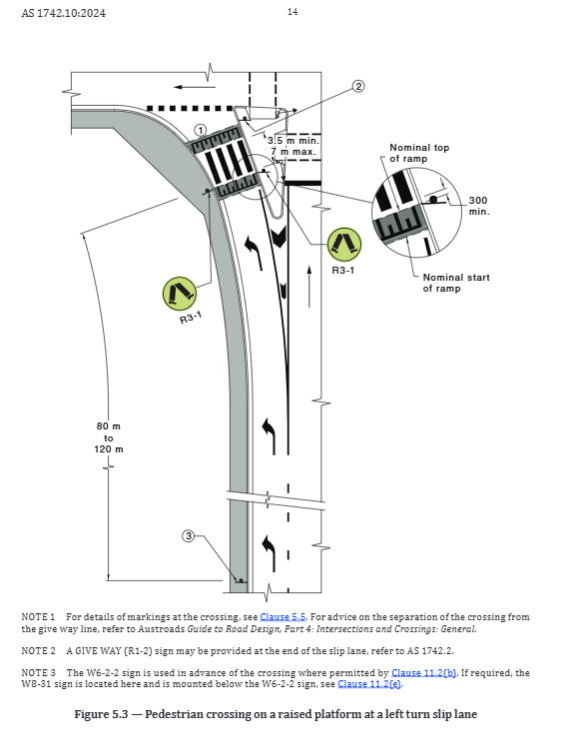
‘Raised Safety Platform’ (RSP) style pedestrian crossings provide an illustrative example of how easily misalignment between VR, AS, AGTM and Supplements can occur. RSPs are being increasingly used to encourage lower driver speeds at crossing points to improve safety for pedestrians and cyclists (VicRoads Road Design Note 03-07). Design parameters provided by AS 1742.13:2009 and 1742.10:2024 show that an RSP consists of a raised pavement with yellow treatment, ‘piano key’ line marking, preceded by a give way line and signs. Used in a slip lane as shown in Figure 1, neither pedestrian crossing lights nor traffic lights are used to control road users.
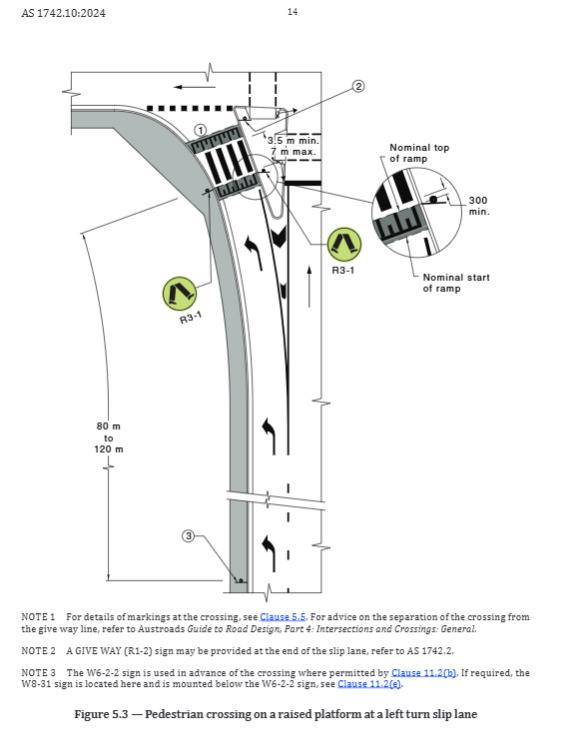
The RSP in Figure 1 however does not clearly fit into a specific type of ‘crossing’ recognised by the VR. For example, the RSP in Figure 1 is not a ‘pedestrian crossing’ as defined by VR rule 81(3) as an area of road:
(a) at a place with white stripes on the road surface that—
(i) run lengthwise along the road; and
(ii) are of approximately the same length; and
(iii) are approximately parallel to each other; and
(iv) are in a row that extends completely, or partly, across the road; and
(b) with or without either or both of the following—
(i) a pedestrian crossing sign;
(ii) alternating flashing twin yellow lights.
In Figure 1, the RSP lacks ‘white stripes… of approximately the same length’ as required by the VR. On this basis, obligations for drivers and riders travel at speeds that allow safe stopping, to give way to pedestrians on or entering the crossing, and to keep the crossing free from obstruction, are not clearly triggered by this design (VR rule 81(1), 81(2), 128A, 172).
The RSP in Figure 1 is also not a ‘marked foot crossing’ (VR rule 59, rule 65, rule 128A, rule 173) defined as an area of a road:
(a) at a place with pedestrian lights facing pedestrians crossing the road and traffic lights facing vehicles driving on the road; and
(b) indicated by a different road surface, or between 2 parallel continuous or broken lines, or rows of studs or markers, on the road surface substantially from one side of the road to the other.
While the legally binding example linked to the definition of ‘marked foot crossing’ states that ‘brick paving’ across a bitumen road can be used to indicate a crossing, the RSP in Figure 1 does not use a surface treatment stated in the VR as indicating a ‘marked foot crossing’. On this basis, obligations for drivers and riders to give way, stop or keep crossings clear, and contribute to behaviours required in manoeuvres such as hook turns are not clearly triggered by RSP design.
If neither pedestrian crossing nor marked crossing rules apply, road user behaviour at the RSP in Figure 1 may be determined by non-specific road crossing rules in VR Part 21. In this Part for example, VR rule 353 states that a driver ‘turning from a road at an intersection’ must ‘give way to a pedestrian who is crossing the road that the driver is entering’. In some locations, such as that in Figure 1, rule 353 is a poor fit for RSPs that are set back from, not ‘at’, ‘an intersection’ as defined by the VR. In Figure 1 annotations indicate RSP placement to be at least ‘7 metres’ before the intersection as required to store ‘one medium sized car’.
The RSP in Figure 1 is also not clearly a crossing on ‘the road the driver is entering,’ if it is installed on the slip road that the driver is exiting. In circumstances where neither specific nor general rules in the VR provide a good fit for the RSP, behaviour expectations may be unclear and put the safety of pedestrians at risk. Misalignment relating to pedestrian crossings illustrates the importance of utilising interpretative tools within laws such as the VR, to locate the most specific road rule applicable to the road environment, and to ensure alignment with defined terms from dictionaries, etc, that provide key reference points in the VR.
Bicycle lanes
Bicycle lanes are defined in the VR and AS. Both definitions recognise a bicycle lane as a ‘lane’ on a road (VR, rule 153(4); AS1742.9.2018) that can be used by bicycles and, jurisdictions like Victoria, e-scooters. While the VR and AS also used similar terminology to describe a bicycle lane by its physical characteristics, bicycle lane appearance in road environments did not always match these descriptions, which has important implications for VR rules.
The VR and AS describe the way that bicycle lanes start and end similarly. For example, bicycle lanes may begin and end by reference to bicycle lane signs. The face plate detail of a bicycle lane sign is consistent between law and design, as a picture of the traffic sign used for bicycle lanes as specified in AS1742 is set out in VR schedule 2. As a matter of statutory interpretation, images that appear in schedules to the VR are legally binding (VR rule 3, endnotes ‘Readers’ Guide’). Alternatively, bicycle lanes can also be established by using a combination of road markings. VR rule 153(4) describes relevant road markings that indicate the start of a bicycle lane as a combination of a white bicycle symbol and the word ‘LANE’ painted in white, and the end as the words ‘END LANE’ painted in white. AS1742.9 compliant road markings appear in VR schedule 2 that contribute to the legally binding obligations for road users imposed by the VR.
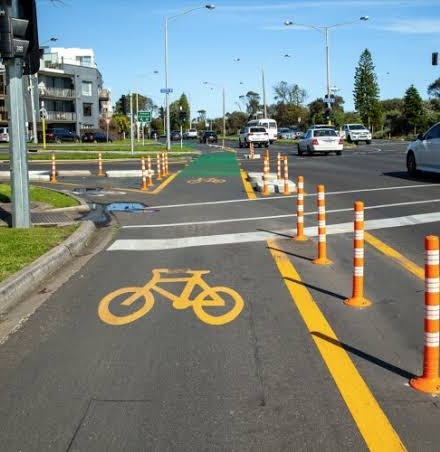
However, despite the use of similar wording, bicycle lanes that exist in many locations around Victoria do not match these requirements, and where not aligned with VR, do not create a ‘bicycle lane’ to which the VR applies. A key misalignment exists where bicycle lanes are indicated by yellow coloured line markings. Traditionally used to indicate temporary traffic management at worksites, (Standards Australia, 2018; VicRoads, 2015, 2021), yellow lanes have been used to create bicycle lanes in the Victorian ‘pop up bicycle lane’ program across Melbourne (Transport Victoria, 2025b). Figure 2 shows the use of yellow line markings (solid lines and bicycle symbol) that are intended to indicate the presence of a ‘bicycle lane’.
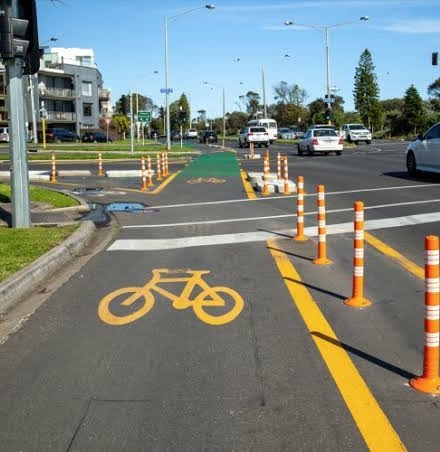
The use of yellow road markings in Figure 2 is misaligned with the requirements of VR rules 153(4) and does not create a ‘bicycle lane’ as regulated by bicycle-specific rules in the VR. Drivers and riders are not necessarily prevented from using the road ‘as if’ yellow line markings created a bicycle lane, nor do they necessarily breach rules by driving on areas of road where these markings occur (e.g., VR rule 158 permit driving in ‘special purpose lanes’ which include bicycle lanes in certain circumstances).
Misalignment between road design and road rules creates opportunities for unsafe road user negotiations, and potentially perverse decisions about liability for crashes that do not reflect the rules that road users may expect will apply based on the appearance of the road environment. In the case of bicycle lanes, exercising discretion allowed in design guidelines and standards to install bicycle lanes using yellow line markings creates misalignment with the VR. In circumstances where the physical presentation of a bicycle lane on a road does not match the definition of ‘bicycle lane’ in the VR, the traffic management device may not be recognised as a ‘bicycle lane’ as referred to in the VR.
Sharrows
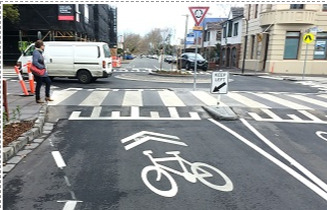
Traffic management devices called ‘sharrows’ are intended to highlight cycling routes and recommend lateral on-road positioning of a cyclist, while alerting all road users to the presence of bicycles on the road (VicRoads, 2016). Figure 3 shows sharrows as a white bicycle symbol line marking painted below white single or double arrows.
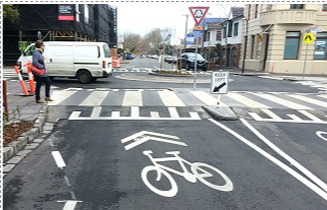
While sharrows provide visual information for drivers and cyclists on roads, line markings shown in Figure 3 are not recognised in the VR and thus no behaviour standards exist for road users when sharrows are present.
As an indicator of shared road environments, sharrows are somewhat of an anomaly. Devices used to indicate other kinds of shared road environments are defined in the VR and trigger certain road user behaviours. For example, ‘shared zones’ are recognised to be places with increased interaction between drivers and pedestrians and attract lower speed limits under VR rule 24. Drivers are required to give way to pedestrians in shared zones (VR rule 83). While it is not necessary that interactions between drivers and cyclists in the presence of sharrows are treated in same as between drivers and pedestrians in shared zones, the recognition of some types of shared road environments (e.g., shared zones), but not the other (e.g., sharrows), highlights an important misalignment between Supplements and the VR that could cause confusion about how drivers should behave around vulnerable road users in these locations.
Riding e-bicycles and e-scooters
The VR specifies behaviour rules for different kinds of road users. Drivers, riders and pedestrians engage with roads and road-related areas through their use of different kinds of vehicles and/or personal transport or leisure devices. In most cases, the VR defines these kinds of vehicles and establishes the place and mode of use for the relevant road user. Roads are used by drivers of passenger vehicles, trucks and buses, as well as riders of motorcycles and bicycles. Riders may also ride bicycles on road-related areas such as shared paths, and in certain circumstances, footpaths. Pedestrians use shared paths and footpaths for walking, as well as use of wheelchairs, electric mobility devices, skateboards and scooters. However, new technologies have expanded the types of devices available to be used by riders and pedestrians, and the relative accessibility of bicycle technology means that users can modify their own vehicles (Napper, 2020). E-bikes and e-scooters illustrate the importance of aligning vehicle design and road rules to support the objectives of a self-explaining road.
The VR facilitates riders to ride bicycles that are now defined to include both pedal bicycles and electric variants, including an ‘power-assisted cycle within the meaning of vehicle design standards, as amended from time to time’ (VR, dictionary; Transport Victoria, 2025a). As defined in the Vehicle Standard (Australian Design Rule – Definitions and Vehicle Categories) 2005 (the document referred to as the source of this definition in notes that follow the VR definition) a ‘power-assisted cycle’ aligns with characteristics set out in the VR in relation to maximum continuous power output (200 watts). In addition however, vehicle standards also state that a ‘power-assisted cycle’ is an ‘electrically power-assisted cycle’, which is separately defined as an:
‘electrically-powered pedal cycle with a maximum continuous rated power of 250 watts, of which the output is:
(a) progressively reduced as the cycle’s travel speed increases above 6 km/h; and
(b) cut off, where
(i) the cycle reaches a speed of 25 km/h; or
(ii) the cyclist is not pedalling and the travel speed exceeds 6km/h.’
The alternative definitions referring to different power outputs (200 watts vs 250 watts) create opportunities for misalignment between VR and vehicle design standards as it is unclear which power output is the maximum power for the purposes of the VR. An e-bike that meets VR specifications for a bicycle will be regulated as a type of bicycle under the VR. However, an e-bike that exceeds these specifications becomes a ‘motorbike’ for the purpose of the VR, which relies on the definition of motor vehicle in section 3 of the Road Safety Act 1986 (Vic). Theoretically, as a motorbike, this subjects the overpowered e-bike to motorbike-specific rules including registration and driver licensing requirements (Road Safety Act 1986 (Vic) section 7, section 18), despite not otherwise being capable of being a motorbike as defined in other laws (e.g., ADR 57/00 which dictates the design of motorbikes manufactured after 1988). Additionally, the rider of an overpowered e-bike is not permitted to use bicycle-specific road infrastructure and rules applicable to bicycle lanes, bicycle storage boxes, advance bicycle crossing lights, or use shared paths (VR, Part 15 division 1). The legal consequences of exceeding defined specifications could be disproportionate to the practical difference that a small amount of additional power, say 25watts to increase the total power to 275watts compared to 250watts, makes to a rider. Nevertheless, should a crash occur, the power output of an e-bike that exceeds specifications may be considered as a factor in determining criminal or civil liability under road safety laws or in negligence (Johnston & Antolak-Saper, 2023).
E-scooters face similar definitional challenges. As defined in the VR, an e-scooter is a vehicle designed for use by one person that:
(a) transports a person while the person is either—
(i) standing on the vehicle; or
(ii) sitting on a seat that is structurally part of the vehicle or purposely built for and correctly installed on the vehicle; and
(b) has 2 wheels (one in front of the other); and
(c) has a footboard between the front and rear wheels; and
(d) is steered by means of a handlebar; and
(e) has an unladen mass not exceeding 45 kilograms; and
(f) has a maximum speed capability of 25 kilometres per hour when ridden on level ground; and
(g) can be propelled by both of the following—
(i) one or more electric motors;
(ii) a person pushing one foot against the ground.
Like an e-bike, an e-scooter is defined by reference to technical specifications and design features although this is not yet supported by a specific definition or ADR under the Vehicle Standard (Australian Design Rule – Definitions and Vehicle Categories) 2005. The VR definition of e-scooter is very similar to a ‘electric personal transporter’ (e.g., segway) used by pedestrians on road related areas (VR, dictionary) and regulated by pedestrian-specific rules (VR, Part 14 division 3).
E-scooters that meet the defined specifications may be ridden on certain roads with speed limits not exceeding 60km/hr, riders may use bicycle infrastructure such as bicycle lanes, storage boxes and crossing lights, and be ridden on shared paths (VR, Part 15 division 2). However, unlike e-bikes, e-scooters that exceed the defined specifications cannot be ridden on roads or road related areas by a different category of road user and/or different type of vehicle. Again, there may be little practical difference between an e-scooter weighing 44kg to satisfy weight specifications compared to an e-scooter weighing 46kg.
As the number of crashes involving e-scooters increase, whether an e-scooter complies with these requirements could affect the liability of a rider in the event of a crash. Recent parliamentary inquiries, government reporting, and legislative change in New South Wales (Parliament of New South Wales, 2025), Queensland (Department of Transport and Main Roads, 2025), Western Australian (Parliament of Western Australia, 2025) and Victoria (Transport Legislation Amendment (Vehicle Sharing Scheme Safety and Standards Bill (Transport Legislation Amendment (Vehicle Sharing Scheme Safety and Standards Bill, 2025)) indicate consistent and comprehensive regulation of e-scooters is required. In the VR, replicating technical specifications to define e-bikes and e-scooters creates opportunities improve consistency through alignment with vehicle design standards.
Discussion
Examining alignment from a legal perspective advances existing knowledge of the relationship between laws and provides new opportunities to improve laws affecting the self-explaining road. Analysis of key findings reveal two themes that can support practical steps that practitioners and road authorities might take to avoid misalignment when applying law from various sources. First, the discipline-led approach to obligation setting and second, the practitioner approach to the application of law. These themes also inform actionable recommendations for policymakers, lawmakers, and road authorities, about ways to improve regulatory alignment in the future.
Discipline-led approach to obligation setting
Disciplines of law, engineering, and design approach obligation-setting differently, which is reflected both in the provisions of the VR, AGRD, AGTM, AS, and the approaches taken to apply them. For example, the VR establishes rules with binary compliance options – road user interactions are covered by the VR, or they are not. If VR applies, road users either comply with road rules, or breach them. In comparison, while road design and vehicle design guidelines and standards are based on specific technical requirements, source documents like the AGTM establish standards as ‘discretionary’ and state that ‘Road authorities may vary their practice according to local circumstances and policies… Readers should rely on their own skill and judgement to apply information to particular issues’ to accommodate variation in design processes (Gibbons, 2025).
In practice, norms may develop to follow AGTM in particular ways, and deviate from them in others (Dent, 2012), such as in works contracts that dictate the order of priority between guidelines and standards according to project specifications. Different approaches to obligation-setting in the VR compared to AGTM appeared to contribute to misalignment relating to traffic management devices, which are installed in ways that deviate from line marking colour and format that have consequential implications for VR compliance. To avoid deviating from AGTM standards (etc) in ways that are misaligned with VR requirements, road safety practitioners, road authorities and lawyers may need support to locate laws from their authoritative sources outside their home discipline, and cross-referencing tools that can help to identify relevant requirements for consideration.
Practitioner approach to the application of law
Road safety practitioners approach the information contained in the VR, AGRD, AGTM, AS, Supplements and vehicle design standards very differently. While language is the source of authority in primary sources of law such as the VR, technical specifications, geometric features and material characteristics provide the foundation for secondary sources of law relating to road and vehicle design.
The potential for disconnect between words and technical specifications was evident in key findings on e-bicycles and e-scooters use by cyclists and pedestrians. While the VR were shown to define specific types of bicycles and e-scooters by their physical features, the definition may be ambiguous when compared to technical specifications in design standards. Replication of technical information in the legal definition of e-scooters for example, created opportunities for misalignment about how vehicles that fell outside those specifications would be treated in the VR. To avoid creating or worsening misalignment between laws relating to different parts of the self-explaining road, road safety practitioners, road authorities and lawyers should refer to discipline-specific explanatory materials and utilise discipline-specific interpretation tools (dictionaries, schedules, technical guides, etc) provided for in the relevant laws to better understand terminology.
Law that contributes to the self-explaining road operates in an interdisciplinary space in which legal obligations that are strict or absolute can become easily misaligned with road environments constructed according to design standards and guidelines that allow for discretion. Despite the use of similar terminology, the meaning of words may be ‘lost in translation’ due to discipline specific concepts, principles, and applications. This does not mean that one approach is right and the other is wrong. Rather, differences between disciplines, vehicle guidelines and standards must be accommodated if laws are to be aligned.
In summary, misalignment between existing laws may be avoided by taking practical steps such as:
-
Identifying law from its authoritative source. For policymakers, legislators and lawyers dealing with road rules, this means locating AGTM, AGRD, Supplements and Standards information from Austroads, a road authority, or from Standards Australia. Legislation and subordinate legislation can be accessed by policymakers, road authorities, and practitioners from Commonwealth (Federal Register of Legislation) and state or territory (NSW Legislation; Queensland Legislation; South Australian Legislation; Tasmanian Legislation Online; Victorian Legislation; Western Australian Legislation; ACT Legislation Register; Northern Territory Legislation) legislation websites. Legislation, subordinate legislation and reported case law are publicly available from search engines such as ‘Austlii’ (Australian Legal Information Institute).
-
Checking for explanatory materials and being aware of discipline-specific conventions that affect meaning. Explanatory guides and materials may be published by discipline-appropriate regulators and road authorities. Some Australian States and Territories (e.g., Victoria and South Australia) road rules legislation include a ‘Readers’ Guide’. While the Readers’ Guide itself is not legally binding (VR rule 9), it can be used to identify interpretive features of law such as dictionaries of defined terms, explanatory notes, diagrams, and examples (James et al., 2024). ‘Part I’ to the AGRD and AGTM respectively, provide guidance and instruction on matters of road design.
In both cases, lawmakers and road authorities are encouraged to review laws to identify and resolve existing misalignment and to create tools that can be used by an interdisciplinary audience to highlight connection between laws across disciplines.
Study strengths and limitations
The main strength of this study is the interdisciplinary review of primary and secondary sources of law affecting road user behaviour, road design and vehicle design for pedestrians and cyclists from a legal perspective and through a lens of the self-explaining road. For legal specificity, this study focused on Victoria, Australia. Readers outside Victorian should consider laws that apply in their relevant jurisdiction. This study examined VR authorised version 24 that incorporates amendments to 30 September 2025, and the AGRD, AGTM, Supplements, AS and vehicle design standards effective on 30 October 2025.
While the specificity of this study is a strength, it is also a limitation. This is not an exhaustive review of laws relating to road safety but illustrates and explains how misalignments can occur between laws.
Conclusions
This study has illustrated the occurrence of misalignment between laws affecting road user behaviour, road design and vehicle design, in relation to traffic management devices used by pedestrians (raised safety platforms) and cyclists (bicycle lanes and sharrows) and descriptions of e-bikes and e-scooters in VR compared to vehicle design standards. By explaining how misalignment may have occurred, it offers new perspectives on how misalignments may be minimised by practitioners, regulators, road authorities, policymakers, lawmakers and lawyers when dealing with road rules, road design and vehicle design standards and guidelines. This study recommends that lawmakers and road authorities review laws to identify and resolve existing misalignment and create tools that can be used by an interdisciplinary audience to prevent misalignment recurring.
Importantly, preventing misalignment will minimise liability risks for road users who breach road rules design following cues created by road design. In addition, preventing misalignment will reduce opportunities for inconsistent or unpredictable behaviours around traffic management devices that are designed to elicit specific behaviours under the road rules.
AI tools
Elicit was used to assist in searching existing literature that referred to law in the context of self-explaining road.
Acknowledgements
Georgina McMenamin BEng (Civil) (Hons) / LLB, Research Assistant.
Funding
This research did not receive any specific grant from funding agencies in the public, commercial, or not-for-profit sectors.
Data availability statement
No materials, data nor protocols were used.
Conflicts of interest
The author declares that there are no conflicts of interest.