Introduction
Roundabouts, recognised for their efficiency in managing intersection traffic and enhancing road safety, have been the subject of extensive research globally. This research focused on single-lane roundabouts, which are the most prevalent type in Croatia and worldwide. The geometric design of roundabouts plays a significant role in influencing vehicle behaviour and safety outcomes (Choi et al., 2011; Flannery, 2001; Novák et al., 2018). This research underscores the practical implications of specific geometric characteristics of roundabouts, such as the number of approaches, entry width, and circulatory lane width, which significantly impact vehicle speeds and crash rates.
Vehicle speed at roundabouts is a critical factor that affects operational efficiency and safety. Vehicles tend to slow down significantly when navigating roundabouts, which can reduce crash severity and frequency. However, the relationship between vehicle speed reductions at specific segments of a roundabout and the corresponding impact on crash rates remains complex and warrants further investigation. Crash rates at roundabouts are influenced by multiple factors, including the roundabout’s geometry (Daniels et al., 2011). For instance, multi-lane roundabouts have been associated with higher crash rates than single-lane roundabouts due to increased complexity and conflict points (Johnson, 2023). Moreover, the entry and exit design can also significantly affect crash occurrences, with a substantial proportion of crashes occurring at these points (Novák et al., 2018; Polders et al., 2015).
Various countries have distinct regulations for roundabout design, which can differ significantly, particularly in terms of geometry and estimated capacity (Direkcija Republike Slovenije za ceste, 2012; Kennedy, 2007; Ministry of Transport, 2009; Spacek, 2004). In Croatia, the most recent guidelines for roundabout design were issued in 2014 (Hrvatske ceste, 2014). These guidelines primarily apply to state roads, but due to the absence of other technical regulations, they are widely utilised for all road categories within and outside urban areas. However, some aspects of the Guidelines lack support from research conducted in local conditions, as such research endeavours are extensive and time-consuming. Given the variability in roundabout designs and the mixed findings regarding their safety impacts (Macioszek et al., 2018; Numpaque et al., 2020; Winston, 2020), there is a need for a comprehensive analysis that explores the relationship between roundabout geometry, vehicle speed, and safety. The aim of this paper was to investigate the above-mentioned relationships focusing on an adapted design of single-lane roundabouts that considers local traffic conditions and road user behaviour.
State of the art
One of the most significant safety advantages of roundabouts is reducing conflict points, from 32 at a typical four-leg intersection to 8 in a roundabout. Compared to typical intersections, crashes at roundabouts tend to be less frequent, and rear-end collisions resulting from right-hand turns are generally less severe (Ambros et al., 2016; Flannery, 2001). Consequently, there is a significant issue of underreporting, as road users often choose not to report crashes to avoid financial and administrative burdens. As a result, the available crash data are often incomplete and do not accurately reflect the true safety performance of the roundabout. On the other hand, traffic conflicts, as independent events in theory models, can be used to estimate the risk and likelihood of various collision types, as well as evaluate traffic safety (Gettman & Head, 2003; Howlader et al., 2024; Tarko, 2021).
Smaller roundabouts with tighter geometries, as noted by Kennedy et al. (2007), tend to enforce lower speeds, which correlates with reduced crash rates and injury severity. Yoshioka et al. (2017) emphasised the importance of the smaller entry radius and the deflection angle for minimising speed variation at roundabout entries. Wider entries can lead to higher speeds and increased crash risks (Flannery, 2001). Mahdalova et al. (2013) also highlighted the importance of controlling speeds at entry points through appropriate geometric configurations, suggesting that central island size and lane width influence safety outcomes.
The central island is important in forcing vehicles to navigate at lower speeds, particularly when combined with proper deflection at entry points. Lower speeds result in fewer crashes and less severe outcomes. Smaller inscribed circle diameters enforce lower speeds, reducing crash risks (Ambros et al., 2016; Choi et al., 2011). Research indicates that roundabouts reduce vehicle speeds, especially at entry points, where deflection forces drivers to slow down (Choi et al., 2011; Deluka-Tibljaš et al., 2018). Higher deflection enhances safety by reducing conflicts between entering and circulating traffic (Ahac et al., 2016; Kennedy, 2007). The key factor in several studies, that has the greatest impact on the crash rate, is average daily traffic (Daniels et al., 2011; Federal Highway Administration, 2010; Šenk & Ambros, 2011).
However, research findings are not consistent. Pilko and Šarić (2018) showed that the roundabouts with smaller inscribed diameters often show a lack of deflection in vehicle trajectories, leading to faster speeds and increased collision risk. Research in the Czech Republic (Šenk & Ambros, 2011) showed a higher crash rate for two-lane roundabouts and narrower traversable aprons. Further, while circulatory roadway width with narrower lanes have been shown to enforce safer speeds (Brilon, 2005), Kim and Choi (2013) found that reducing the circulatory lane width correlates with a higher likelihood of crashes and suggested that carefully calibrating lane dimensions is essential for maintaining low vehicle speeds. In terms of island size, Daniels et al. (2011) reported that larger islands may encourage higher speeds and result in more single-vehicle crashes.
The performance of traffic systems is influenced by various stochastic parameters, making testing in real-world conditions time-consuming with a possible negative impact on traffic safety of all road users (Otković et al., 2013). One approach to test traffic system performance is microsimulations. Microsimulations are a modelling technique that considers various variables and parameters to model the movement of individual vehicles within a roundabout and provides a detailed view of traffic flow. It enables the assessment of how well a roundabout handles traffic under different conditions by simulating vehicle behaviour, such as acceleration, deceleration, lane changes, merging, and predicting potential conflicts (Li et al., 2011; Luo et al., 2023; Šurdonja et al., 2015). Microsimulations, specifically using VISSIM software combined with the Surrogate Safety Assessment Model (SSAM), provide a valuable framework for assessing traffic safety at roundabouts by simulating vehicle interactions and predicting conflicts. SSAM is a software application designed to analyse trajectory files produced by microscopic simulation programs and compute surrogate safety measures. It automatically identifies, classifies and evaluates traffic conflicts. This method removes the subjective nature linked to traditional conflict analysis techniques and enables the evaluation of a facility’s safety within a controlled environment prior to potential crashes (K. M. Kim et al., 2018; Vasconcelos et al., 2014). Studies have validated the use of VISSIM. Bulla Cruz et al. (2020) investigated the use of traffic conflict analysis in VISSIM to measure roundabout safety, showing that calibrated microsimulations can accurately predict traffic conflicts and encounter severities, thus offering a proactive safety assessment. Giuffrè et al. (2018) demonstrated that microsimulation output from VISSIM, combined with SSAM, could effectively predict crashes based on surrogate safety measures such as conflict rates during peak traffic hours.
Materials and Methods
This research study gathered data from nine medium-sized urban roundabouts located in the broader area of the city of Rijeka, Croatia. The classification of medium-sized roundabouts was according to the Croatian Guidelines (Hrvatske ceste, 2014) with outer radii ranging from 15 to 18 metres. This type of roundabouts is typically constructed at intersections in urban areas that experience higher traffic loads. Their design and technical elements permit speeds of up to 40 km/h with an estimated capacity of 20,000 vehicles per day (Hrvatske ceste, 2014). The roundabouts exhibit a mix of radial and tangential entry geometries, with a majority characterised by radial designs (Austroads, 2023).
Crashes at roundabout are typically low severity and many road users in Croatia do not report the crash to avoid potential penalties. As a result, the official crash records at roundabouts in this study are likely to be considerably underreported and fail to accurately represent the true situation. Therefore, the official statistics were excluded from this analysis, and potential conflicts that can lead to crashes were analysed.
Using real traffic and geometric data, a microsimulation model of each roundabout was created, and the trajectories of each vehicle were determined. The number of potential conflicts was assessed to determine the correlation between potential conflicts and the geometric and traffic parameters of the roundabout.
The available data on traffic conditions at the intersection were analysed:
-
traffic parameters: speed, traffic structure, traffic volume
-
geometric parameters
Traffic parameters
To ensure the quality and integrity of the database, field measurements were conducted using Datacollect SRD radar traffic counters without interrupting the traffic flow. On each approach, traffic counters were placed on a street light pole or traffic sign pole at a height of 2.20 m. Data in both directions were continuously recorded for 24 hours on two weekdays (Wednesday and Thursday). The recorded traffic volumes were validated against the average annual daily traffic data from the Report (Hrvatske ceste d.o.o., 2023) and provided under an Open Licence.
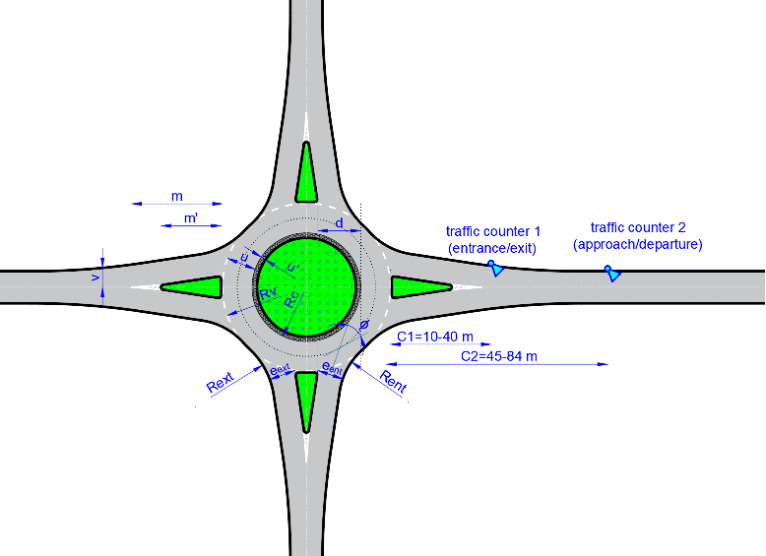
The placement of the traffic counters is illustrated in Figure 1 and the distance from the entrance to the roundabout for each approach is detailed in Table 2 (measured as C1 and C2 in metres). The traffic counters provide insights into the daily traffic volume at each approach (AP) of the roundabout (RB) (Table 1). The main direction, highlighted in bold, indicates the direction with the highest traffic volume. Additionally, the data include relevant speed metrics for each approach: maximum speed (vmax), daily operating speed (v85) and percentage of vehicles exceeding the posted speed limit (vexc).
The vehicle speed is categorised by position on every approach:
-
approach speed: 45-85 m from the roundabout entrance
-
entry speed: 10-40 m from the roundabout entrance
-
exit speed: 10-40 m from the roundabout exit
-
departure speed: 45-85 m from the roundabout exit
Table 1 also specifies the posted speed limit on the road as well as the regulations in place when approaching a roundabout (PSL road/PSL roundabout). Daily traffic volume at observed roundabouts ranged from 12,000 to 24,000 vehicles. It should be noted that the Guidelines (Hrvatske ceste, 2014) advise against using a roundabout if more than 75 percent of daily traffic passes through the main direction; ideally traffic should be evenly distributed at around 50 percent. Four study roundabouts do not meet this criterion (1, 6, 7, 9). While entry v85 generally fell within the posted limit, significant variability was observed across approaches. Notably, approximately 40 percent of vehicles exceeded posted speed limits at certain high-volume approaches, with departure speeds also showing substantial non-compliance.
Geometric parameters
To gather data on the applied geometric elements, detailed design drawings of each roundabout were utilised. The specific geometric elements for which there are recommendations and limit values in the Guidelines (Hrvatske ceste, 2014) were identified (Table 2, Figure 1), including:
-
outer radius of the roundabout [m] (Rv)
-
width of the circulatory road [m] (u)
-
entry and exit widths [m] (eent, eext)
-
entry and exit radius [m] (Rent, Rext)
-
traffic lane width on the approach [m] (v)
-
length of the dividing surface [m] (m) – length of the painted area separating the entry and exit lanes at a roundabout approach, horizontal signalisation (includes the length of the island)
-
entrance angle [°] (Φ)
-
deflection [m] (d)
-
length of the island, including the part where it crosses the pedestrian crossing [m] (m’)
-
radius of the central island including traversable apron [m] (Rc)
-
width of the traversable apron [m] (u’)
-
longitudinal slope of the approach [%] (l)
The geometric characteristics of the roundabouts revealed deviations (bold values in Table 2) from Croatian Guidelines (Hrvatske ceste, 2014) in several key elements, particularly in circulatory road widths, which were generally above recommended values.

Traffic microsimulation models
Using the VISSIM software, an individual traffic microsimulation model was developed for each roundabout. The model incorporated field-collected input parameters on traffic volume, traffic structure, entrance and exit speeds, and approach and departure speeds. The vehicle speed in the model was defined by the daily operating speed v85. Although roundabout performance is frequently assessed based on peak-hour conditions, preliminary findings indicated that this approach did not provide sufficient of conflict data for a statistically robust analysis. As a result, each intersection was simulated over a complete 24-hour period to ensure an adequate number of conflicts for statistical examination and captured a wider range of driving behaviours.
Using daily traffic volumes rather than peak-hour data is consistent with practices observed in several other SSAM-based roundabout studies (Bulla-Cruz et al., 2020; Giuffrè et al., 2018). This method also aligns with traditional safety prediction approaches that consider crashes on a daily or annual basis (Daniels et al., 2011; Federal Highway Administration, 2010). While highly congested environments may produce a higher conflict count during peak-hour flows, the single-lane designs and daily traffic volumes ranging from 12,000 to 24,000 vehicles in this specific study area are more accurately represented by a continuous 24-hour simulation. This approach, characterised by a relatively even distribution of traffic, simplifies the simulation while effectively capturing conflict occurrences throughout the day, including off-peak periods that might otherwise be overlooked.
Each intersection underwent a 24-hour microsimulation, with ten simulations conducted for each intersection model to ensure the most accurate results. The mean value of these results was then used. The microsimulations provided vehicle trajectories throughout the roundabout, which were subsequently utilised to estimate conflicts with the assistance of the SSAM program. A total of 90 microsimulations were completed.
Conflicts modelling
The SSAM software was used in this paper to estimate the number of potential conflicts based on the vehicle’s trajectory (as one of the results of the microsimulation models of roundabouts). Aside from using total conflict counts, potential conflicts can also be categorised based on the type of driving manoeuvre and by several measures of severity of the event (Federal Highway Administration & U.S. Department of Transportation, 2008). In the present analysis, time to collision (TTC) was used as a threshold to establish whether a given vehicle interaction is a conflict and the relative speed (DeltaS) as a proxy for crash severity. Their definitions are as follows (Federal Highway Administration & U.S. Department of Transportation, 2008):
-
“TTC” is the minimum time value observed during the interaction of two vehicles. The interaction is tagged as a conflict if the TTC drops below a threshold (1.5s, standard default value )
-
“DeltaS” is the difference in vehicle speeds observed at the instant of the minimum TTC
Conflict classification is generally based on the conflict angle, although link and lane information may affect the classification. The conflict angle is used for classification as follows:
-
crossing: conflict angle > 85°
highest risk in terms of severity because of the angle of impact and high energy transfer
-
rear-end: conflict angle < 30°
generally lower severity but can still result in significant injuries in high-speed scenarios
-
lane-change: 30° ≤ conflict angle ≤ 85°
moderate severity but pose risks of cascading events (e.g. multi-vehicle collisions)
Statistical method
After deriving conflict counts and speed indicators, the study explored correlations among geometric parameters, daily traffic volumes, speed metrics, and conflict data. The Pearson correlation coefficient measured linear relationships, and significance was verified using a two-tailed t-test at the p < 0.05 level. To identify the factors most significantly associated with conflicts, stepwise multiple linear regression was used. Model quality was assessed using the coefficient of determination (R²) and the adjusted R² (Montgomery et al., 2015).
Results
The results are divided into two sections. The first section displays the results of vehicle speeds and the influence of geometric elements. The second section displays the results of microsimulations and the influence of geometric elements, as well as speeds, on the number of potential conflicts.
Operating speed analyses
Tables 3 and 4 present the correlation matrices for traffic and geometric variables, respectively, revealing a moderate inverse relationship between daily traffic volume and entry or exit speeds at certain approaches. As traffic volume increases, queuing tends to occur, prompting drivers to exercise greater caution, which subsequently lowers their entry and exit speeds. There is a strong correlation between entry speed and both exit and departure speeds, indicating that higher speeds during the approach often carry over into the circulatory roadway. Larger entry radii exhibit a weak correlation with increased operating speeds, while narrower circulatory roads appear to reduce the likelihood of excessively high speeds. Additionally, larger exit radii show a moderate positive correlation with both exit and departure speeds. These findings suggest that roundabouts featuring generous exit curves or wide circulatory lanes allow drivers to maintain or even enhance their speed while departing. The outer radius presents only a weak correlation with speed measures, likely due to the narrow range of outer radii (15 to 18 metres). Furthermore, the radius of the central island demonstrates a positive correlation with maximum exit speed.
Conflict analysis
The conflict analysis integrates insights from both microsimulation and statistical analyses to assess potential conflicts influenced by roundabout geometry.
Microsimulation findings
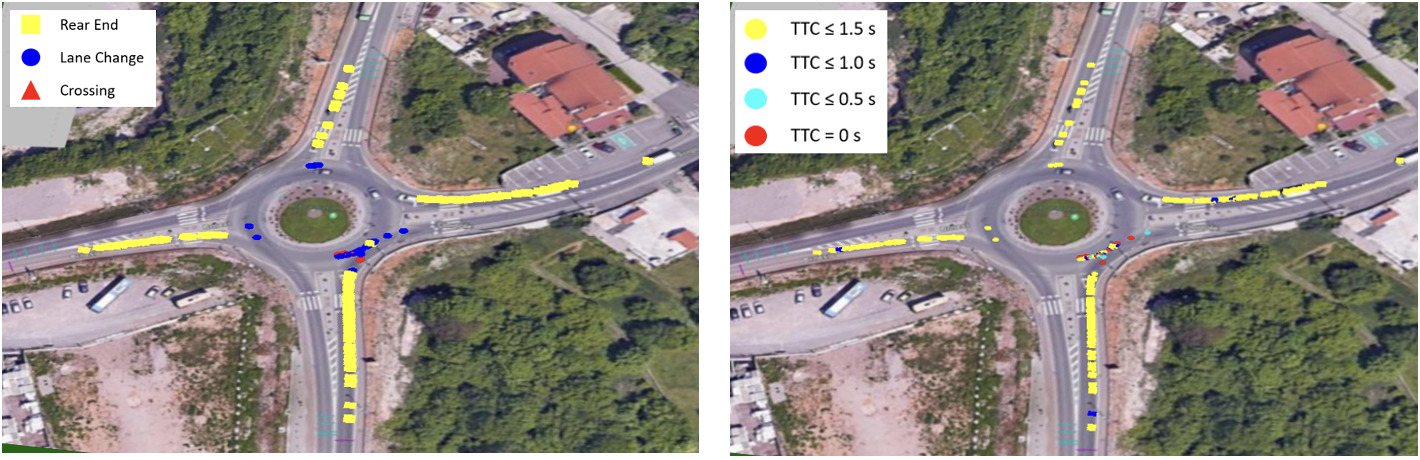
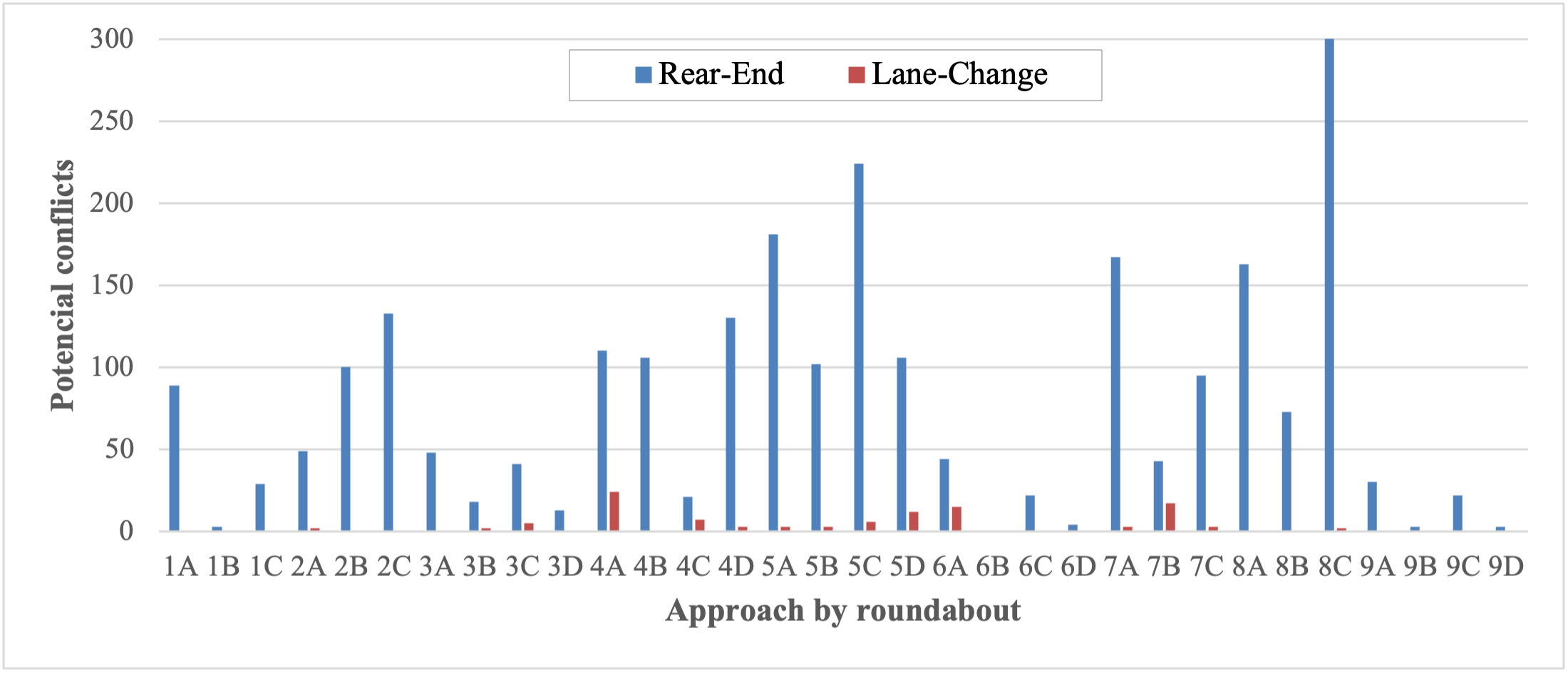
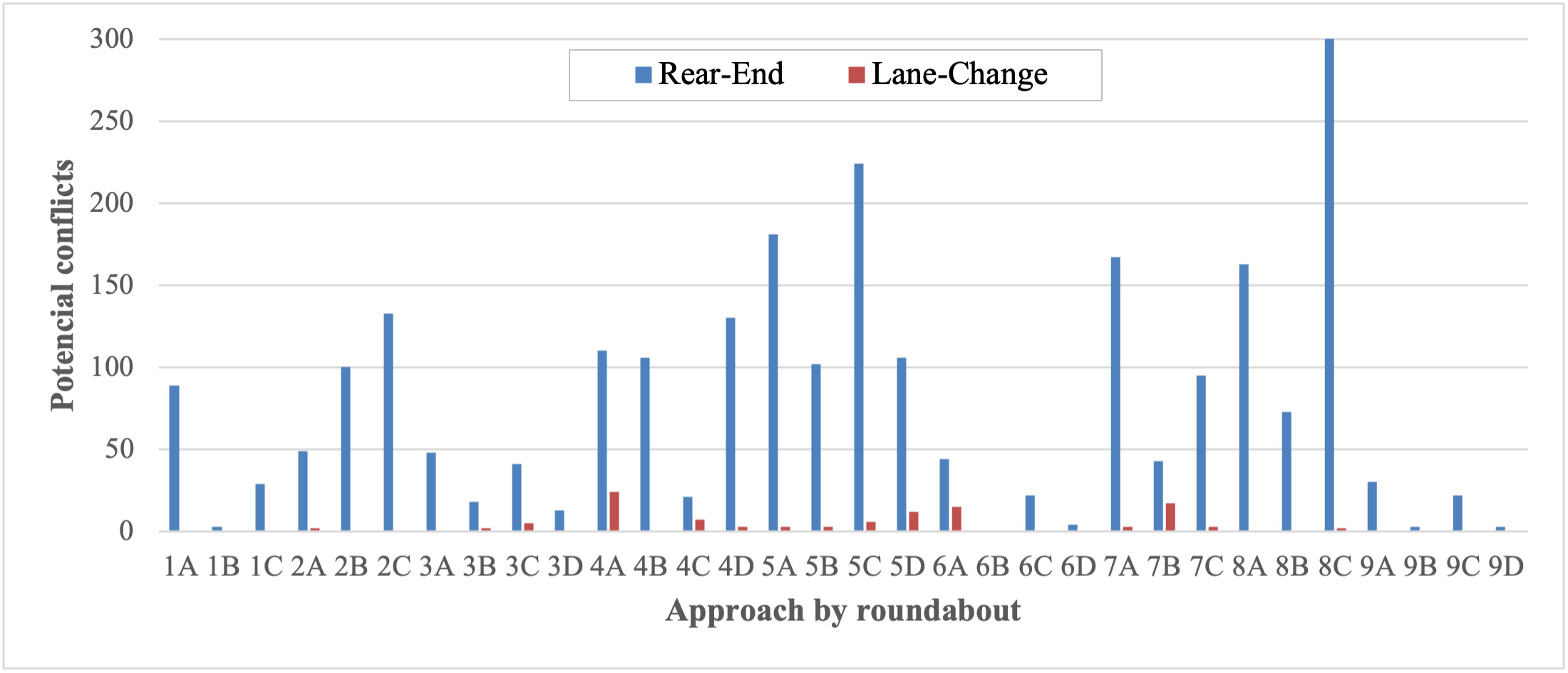
The application of SSAM to the simulated vehicle trajectories allowed for the quantification of potential conflicts at each roundabout. To illustrate the modelling, sample outputs from SSAM are included for Roundabout 5. Figure 2 presents various types of conflicts and their severity and Figure 3 presents the overall number of potential conflicts categorised by type. Lane-change conflicts primarily occur within the circulatory roadway, which may be attributed to variations in lane width according to Croatian Guidelines (Hrvatske ceste, 2014). Figure 3 shows rear-end conflicts are the most frequently observed type, while lane-change conflicts, although less common, still occur. This was consistent across all 9 study roundabouts.
__conflict_severity_(right).png)
Statistical analysis
A stepwise linear regression analysis identified two primary models: rear-end conflicts (Table 5) and lane-change conflicts (Table 6). The model for rear-end conflicts demonstrated substantial explanatory power, with an R² of 0.853 and an adjusted R² of 0.813. The findings indicate that daily traffic volume is the primary predictor of rear-end conflicts, likely due to an increased likelihood of abrupt deceleration at higher traffic demands. Wider entries or exits may provide a slight reduction in rear-end conflicts; however, a larger central island appears to correlate positively with an increase in such conflicts. Conversely, the lane-change conflict model exhibits lower explanatory power, with an R² of 0.368 and an adjusted R² of 0.292. In this model, both an increase in entry width and the presence of a larger central island are associated with a higher frequency of lane-change conflicts.
Discussion
In this study, the interaction between geometric parameters, operational speeds, and potential conflicts at nine single-lane, medium-sized roundabouts in Rijeka, Croatia, was analysed utilising a combination of microsimulation and SSAM-based conflict analysis. The findings provide an in-depth comparison of the relationships among traffic volume and vehicle speed, geometric features and vehicle speed, as well as geometric elements and both rear-end and lane-change conflicts.
Traffic Volume and Speed Interactions
Daily traffic volume emerged as a key factor affecting speed at roundabouts (Table 3) and is consistent with previous findings (Daniels et al., 2011; Šenk & Ambros, 2011). As traffic volumes increased, congestion and potentially driver caution led to lower entry speeds. This aligns with other studies showing that as more vehicles converge on an intersection, the average speed tends to decrease due to queuing and limited overtaking opportunities (Flannery, 2001; Novák et al., 2018). Correlation analysis (Table 3) indicated that higher entry speeds often led to higher exit and departure speeds, a pattern that aligns with findings from Pilko & Šarić (2018), who noted that driver behaviour at roundabout entry could ripple throughout the entire manoeuvre, that is if a driver enters quickly, they are less inclined to slow down inside the circulatory roadway. Although higher-speed throughputs can benefit capacity under certain conditions, this action may also reduce the reaction time available for a driver to yield to pedestrians or accommodate lane changes (Winston, 2020). These findings underscore the need for design strategies, such as tighter entry geometry or additional visual cues, to encourage safe speed reductions, especially at roundabouts with high traffic demand.
Geometric Elements and Vehicle Speed
Analysis of the influence of geometric parameters (Table 4) reveals a low positive correlation between the departure v85 speed and exit radius. Larger exit radius can permit smoother trajectories, occasionally prompting drivers to maintain or even increase speed on departure. A narrower circulatory road, by contrast, appears to act as a self-enforcing speed restraint, which aligns with Kim and Choi (2013) and Brilon (2005); these studies similarly suggest that limiting circulatory road width can deter aggressive driving manoeuvres and help reduce the number of drivers exceeding posted limits.
This study focused on medium-sized roundabouts in Croatia, where outer radii range from 15 to 18 m and do not vary extensively. The negative correlation between the outer radius and entry vexc stands in contrast to Kennedy et.al (2007), who compared different technical regulations worldwide and concluded that larger roundabouts often have higher speeds and crash rates, specifically roundabouts with inscribed diameters exceeding 100 m. The discrepancy between the two sets of findings therefore likely arises from both design and driver behaviour. In the Croatian sample there is relative consistency in roundabout diameters with limited variation. Further, distinct regional driving habits, suggesting that geometric design alone cannot be generalised without accounting for local traffic culture and contextual constraints.
The most pronounced influence on exit and departure speeds is the width of the traversable apron, supporting Šenk and Ambros (2011) research – wider apron contributes to an increase in deflection reducing vehicle speed.
Geometric Elements and Rear-End Conflicts
Rear-end conflicts emerged as the most frequent conflict type, aligning with research indicating that most collisions at roundabouts involve drivers of following vehicles who did not allow sufficient headway to respond safely when the driver in front brakes unexpectedly (Numpaque et al., 2020; Polders et al., 2015).
Regression analysis in this study shows that the strongest predictor of rear-end conflicts is daily traffic volume, in line with Daniels et al. (2011) and the Federal Highway Administration (2010). Greater volumes increase the frequency of potential interactions and the likelihood of sudden braking. Wider entry/exit width and entry radius can disperse queues and reduce abrupt stops, thereby mitigating rear-end collisions. While research by Yoshioka et al. (2017) suggests that larger entry radii might raise speeds and conflicts, our data indicated that, in Croatia’s medium-sized contexts, wider entries alleviate stop-start situations, thus reducing rear-end conflicts (Flannery, 2001). The contrasting findings can be attributed to the fact that the roundabouts studied here were predominantly radial in design, whereas the earlier research in Japan focused on tangential types (Yoshioka et al., 2017). Additionally, a larger central island was linked to more rear-end conflicts, possibly due to the constricted circulating roadway and the resulting unexpected braking or “speed trap” effect (Daniels et al., 2011). This phenomenon underscores the need to balance using a large island to enforce deflection (lower circulatory speeds) and avoiding abrupt speed changes when drivers encounter queues at the approaches.
These findings reinforce the need to optimise roundabout geometry according to specific local traffic conditions and driver behaviours. While narrower entries often promote lower speeds (Mahdalova et al., 2013), local driving patterns, volumes, and the road environment can shift this dynamic in nuanced ways (Choi et al., 2011; Johnson, 2023).
Geometric Elements and Lane-Change Conflicts
Despite being single-lane roundabouts, lane-change conflicts can occur within the circulatory roadway (Figure 2 and 3). Informal multi-lane behaviour can emerge when the circulatory roadway is wider than recommended, encouraging faster-moving or smaller vehicles to pass slower vehicles, thus creating lane-change situations. Entry width and central island radius both correlate positively with lane-change conflicts (Table 6). Wider entries may facilitate side-by-side positioning or overtaking, while a larger central island can push vehicles toward the outer edge of the circulatory roadway, potentially prompting lane changes around slower vehicles. A larger exit radius, which is negatively correlated with lane-change conflicts, can offer a smoother exit path and thus reduce the need for sudden lateral shifts.
Study strengths and limitations
By focusing on single-lane, medium-sized urban roundabouts in Rijeka, Croatia, the study provided tailored insights that consider local traffic conditions and behaviours. The key strength of this research is its reliance on a substantial database gathered from field measurements, allowing for analysis grounded in real-world conditions rather than theoretical models. Microsimulations of empirically observed roundabouts can reveal the mutual influence of parameters that may fall outside the Guideline’s recommendations. Limitations include the study’s focus on medium-sized roundabouts in a specific region, which may affect the generalisability of the findings.
Conclusions
Findings from this study indicate that roundabout geometric design impacts vehicle speed and traffic safety.
Moderately widening entry and exit areas may mitigate abrupt stop-and-go patterns but should be balanced against potential surges in operating speeds. Narrower circulatory roads can help deter speeding and maintain the single-lane character of these roundabouts, whereas larger exit radii and traversable aprons can streamline flow yet risk enabling undesirable speed carryover. Daily traffic volume is the overarching factor that amplifies or tempers these effects, suggesting that roundabout dimensions and deflection angles should be scaled to local traffic forecasts to reduce conflict frequencies.
Microsimulation models based on real traffic data, particularly in combination with the SSAM, were effective in predicting rear-end and lane-change conflicts, validating the hypothesis that specific geometric features can enhance or compromise traffic safety. By leveraging microsimulation and conflict-based safety analyses during the design phase, planners and engineers can identify adverse speed patterns early and tailor improvements to local conditions. The study’s findings show the need for tailored roundabout designs based on local traffic conditions. Future research should build upon these results by extending the analysis to include a wider range of roundabout designs and traffic conditions, especially in varying urban contexts, which can then include an analysis of other road user safety including motorcyclists, cyclists and pedestrians.
Acknowledgements
The work in this paper has been supported by the projects “Optimization of the design elements of the wider zone of the intersection” (uniri-iskusni-tehnic-23-86) and “Transportation infrastructure in the function of the safety of vulnerable road users” (uniri-iskusni-tehnic-23-85) supported by the University of Rijeka.
AI tools
The author acknowledges that Grammarly (v1.2.173.1702) was used in the preparation of this paper to assist with English language expression and clarity.
Author contributions
Conception: S.Š.; design: M.K. and S.Š.; software: M.K.; formal analysis: M.K. and S.Š.; writing – original draft preparation: M.K. and S.Š.; writing – review and editing: S.Š. and A.D.-T.; supervision: S.Š. and A.D.-T.; project administration: S.Š. and A.D.-T. All authors have read and agreed to the published version of the manuscript.
Funding
This research did not receive any specific grant from funding agencies in the public, commercial, or not-for-profit sectors.
Human Research Ethics Review
This study did not require Human Research Ethics Review.
Data availability statement
Data for this research is available with researcher approval from the corresponding author.
Conflicts of interest
The authors declare that there are no conflicts of interest.